

Loose Thoughts on Cross-Country Skiing
I went cross-country skiing and I more or less lived to tell the tale.

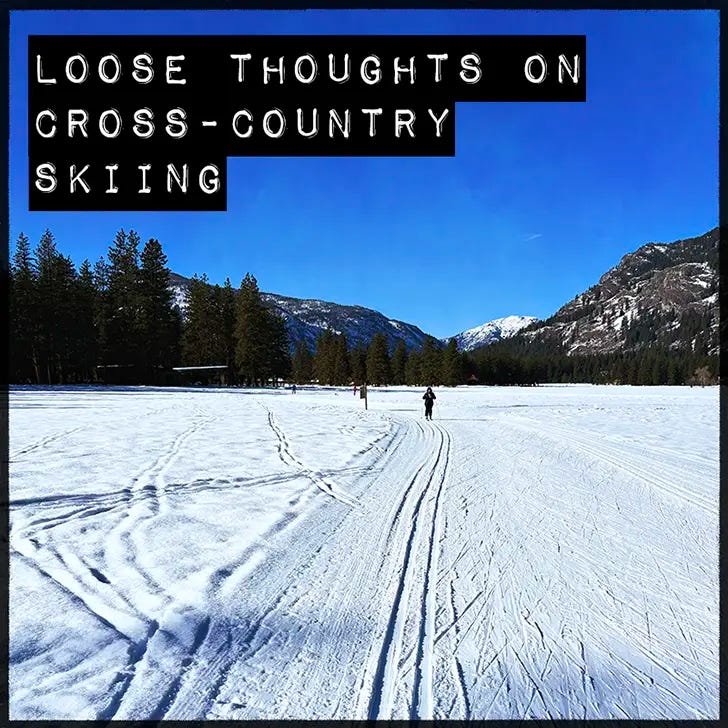
A couple of weeks ago, I went cross-country skiing for the first time since 2011. Before that, my previous trek was in 1996, so a pattern seems to be emerging. We’ll see how good my technique is in 2041.
Much like bicycling, you don’t forget how to cross-country ski. It’s an acquired skill that requires both coordination and balance, but after you get over the initial hump, it sticks with you. And like many Norwegian children, I learned to ski before I could walk. It’s not for nothing that “born with skis on our feet” is an oft-used Norwegian aphorism.
Now, the intention of this post is not to gloat about how awesome a skier I am1 – I managed to pull a muscle the day after the trip – but I do feel cross-country deserves a better rep here in the U.S. Why fight people in ski lifts and get run over by adrenaline-fueled fifteen-year-old snowboarders when you can instead leisurely glide through the woods? It’s a good workout, too.
So, to start with the beginning…
A Brief History
Cross-country skiing has been around as long as the wheel, and can be traced back more than five thousand years. During winter, skis were used throughout Northern Europe for hunting and migration.
The most “photographic” evidence of this is a four-thousand-year-old petroglyph depicting a skier, since dubbed “Rødøymannen.” The name refers to the island of Rødøy, where it was discovered. In later years, some archaeologists claim the petroglyph is not of a skier but rather a boater, so make up your own mind. The 1994 Olympic Committee chose to interpret it as a skier for its commemorative coin, and I’m not sure we’ll ever know what this rudimentary art really portrays. The point is that Norwegians have skied for a long time.


During the 1675–1679 war between Sweden and Denmark-Norway2, Norway formed a cross-country ski battalion that, in 1732, would become a mainstay of the Norwegian military. It was also around then that most skiers switched to using two poles; previously, skiers typically used a single long pole or a spear for balance.
During Roald Amundsen and Robert Scott’s 1911 race to the South Pole, many credit the Norwegian’s use of skis as a decisive factor in the outcome – Amundsen not only won, but also returned without a scratch. Scott and his crew died on the way back.
The Art of Cross-Country Skiing
Today, there are two forms of cross-country skiing: Skating and classic Nordic. While the former is the more common competitive style, the latter is easier and, in this handsome man’s opinion, more fun. One objectively true thing: the “crawl before you walk” adage applies to cross-country. Learn the classic style before you try to skate. During our aforementioned ski trip, there were a lot of beginners who were flailing around, frustrated that they were not making any headway with their skating.
With classic, you mostly stay in groomed trails, which is easier for balance and, unless you’re a skating demigod, also faster.
And, if you insist on skating, for heaven’s sake, do it outside of the groomed trails. Don’t ruin it for the rest of us. Sheesh.
Plowing and Herringbones
Going forward through groomed trails is easy enough as soon as you get the technique down – you just kick yourself forward, using your poles for balance and for an extra oomph. But, how about the hills? How do you climb up without sliding back and glide down without running into a tree?
This is where plowing and herringbones come in.
Unless you’re a pro, you likely will want to use herringbones to get up steeper hills. It, much like skating, should be done outside the groomed trail – you place your feet and skis in a V formation, with the inner edges of the skis digging into the snow. Like I have expertly illustrated:
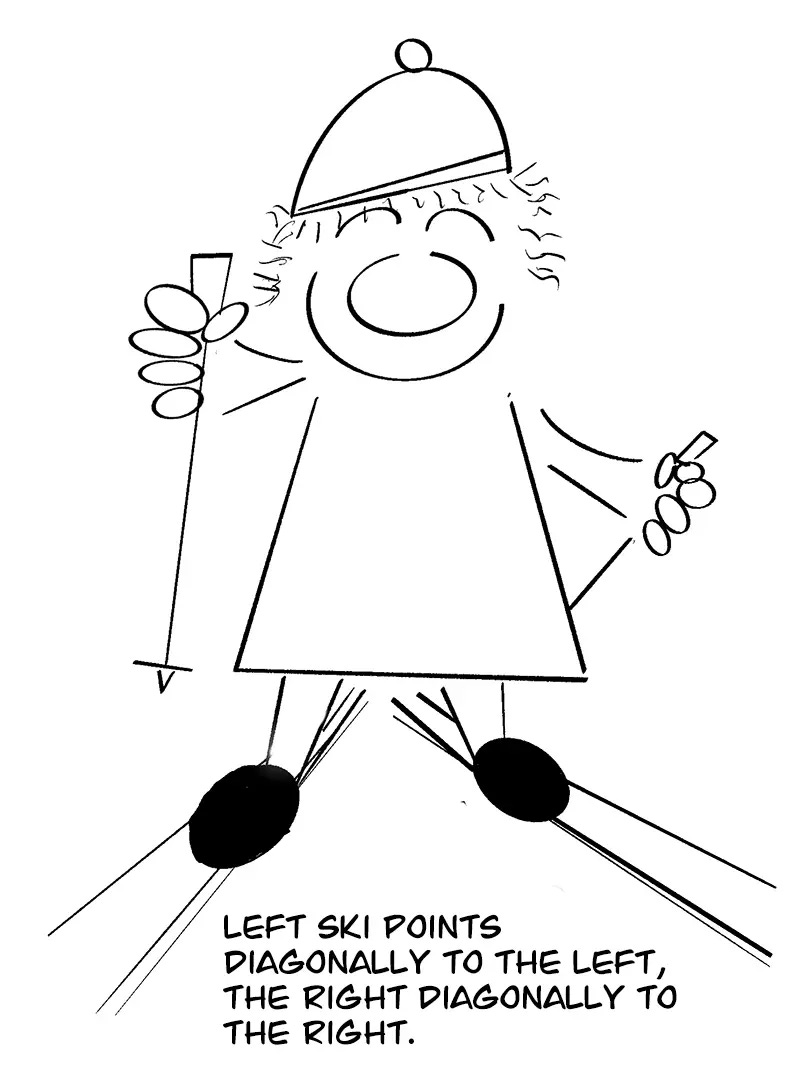
From there, you “walk” by lifting the right ski in front of the left, the left in front of the right, and so on and so forth. The poles push you along.
Plowing downhill – sometimes known as “pizza” – is harder. You point the front of your skis toward the center while keeping your leg muscles and core flexed, so you don’t cross your skis. Keep your knees slightly bent and the poles even with your body for balance. Like this:
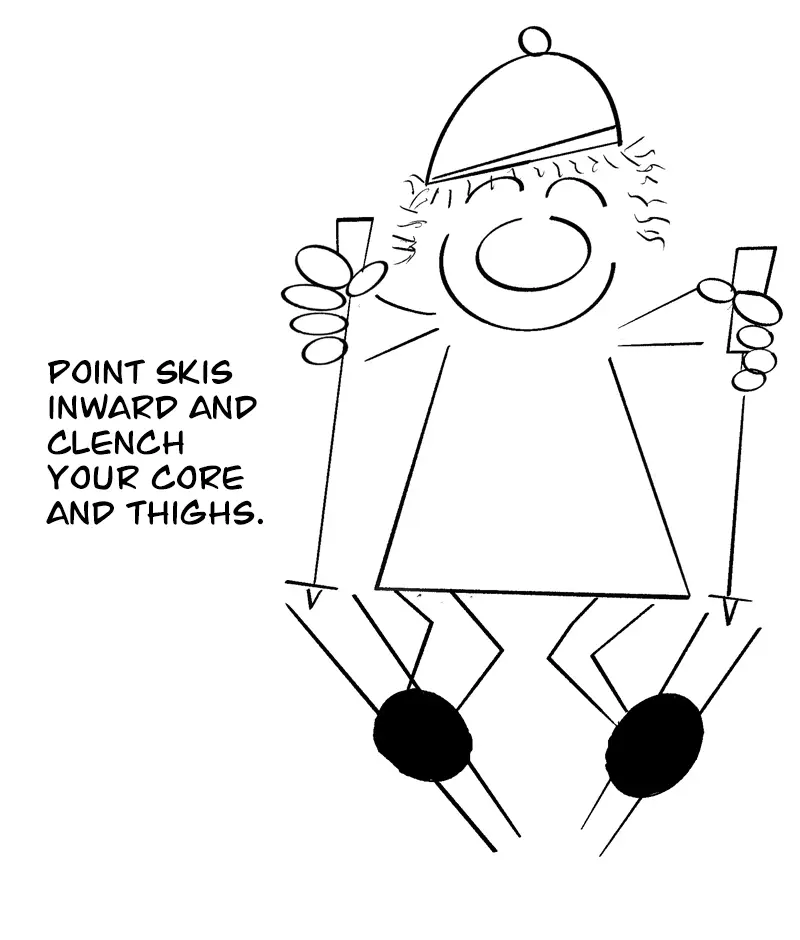
You’ll have to shift your balance left and right to make sure you move forward and not in circles. It’s not a particularly difficult technique, but it works the muscles. Hard. Frankly, if you can keep your balance in the groomed trail without plowing, that’s probably going to be easier.
Books and videos have been published on how to cross-country ski, but there’s not too much more to it than the basic movements. Lean slightly forward and move without falling; herringbone and plow if need be. You’ll be a champ before you know it.
The Olympics
It’ll come as little surprise that Norway stands with more Olympic cross-country medals than any other country. Hundred-and-twenty-nine in total, fifty-two of which are gold.
Marit Bjørgen holds the record for the most Olympic cross-country medals, with a total of fifteen, including eight golds. Close behind is Bjørn Dæhlie, with twelve medals, eight of which are gold. Norway takes its cross-country skiing seriously.
We will see if the streak continues – the Winter Olympics start this Friday, February 6th. Here in the U.S., it streams on Peacock.
The Alien Skier
I was curious what Google Gemini would make of the petroglyph and, well…
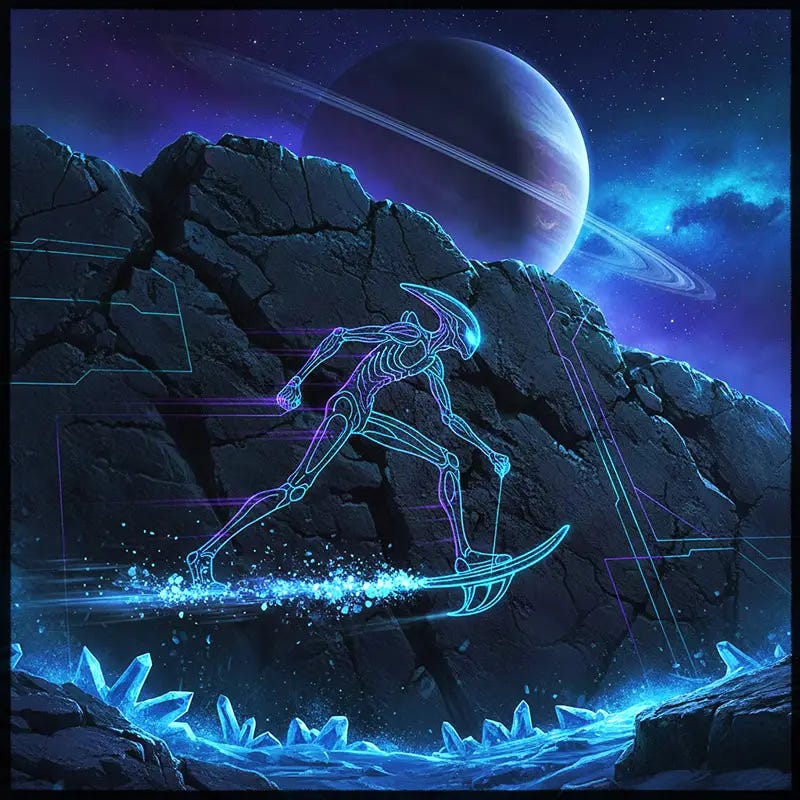
… maybe the alien conspiracists have a point after all.

Merch for the People!
Don’t just read Awesomeness – wear it! This distinguished publication proudly features two official shirts, magnets, stickers, or whatever medium you can think of: The Hallgrrrl and the Zune. Why those? For one, the Hallmark channel and Riotgrrrl are, as I’ve previously stated, the natural combination. And, who didn’t love the Zune?



Go shopping at The Better Taster Boutique for only the finest goods.

The “Rødøymannen” photo (CC BY-SA 4.0) and various factoids come courtesy of Wikipedia’s “Langrenn” article.
Isn’t that a given, after all?
Norway was under Danish rule at the time, alas.
Love this history lesson and the great ski weekend. #coolkidsclassicski