

On Christmas Cards and Red Gnome Hats: Symbols of Norwegian World War 2 Resistance
Never underestimate Norwegian passive aggressiveness.

On December 18th, 1941, the Norwegian flag was, for all practical purposes, banned in Norway. A year and a half after the Nazi invasion, Vidkun Quisling’s puppet regime decreed that any use of the flag that “offended the national sentiment” – a thinly veiled spin on “anti-German sentiment” – was illegal.
Soon after, Santa suffered the same fate.
Christmas cards featuring red-hatted gnomes had been a Norwegian tradition since the 1880s, and the hat itself was a popular Norwegian fashion staple. During the war, its popularity spiked as Norwegians sought to express national pride in the face of German occupation. The Nazi regime took notice, and on February 23rd, 1942, they issued an edict banning not only red-hatted gnomes in Christmas cards but also the actual attire: Red hats were no longer welcome in Nazi-occupied Norway.
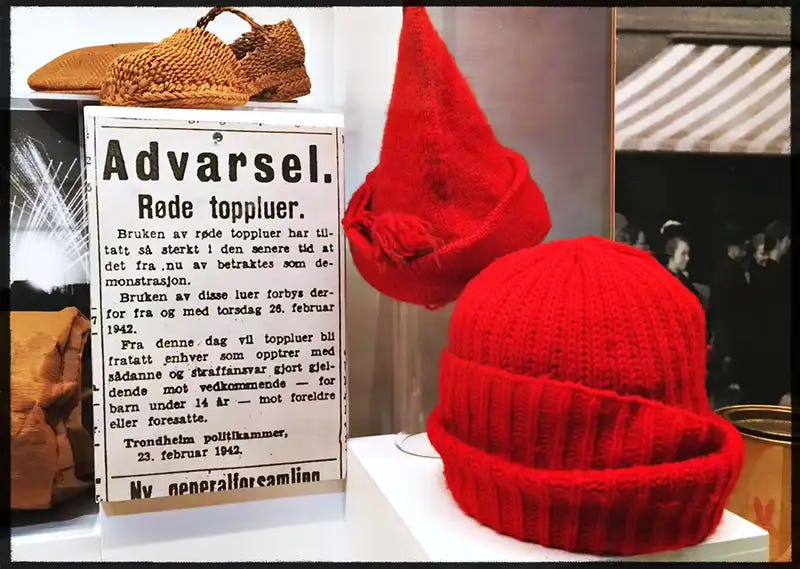
It’s not widely documented exactly how successful the ban was, though the Porsgrunn Dagblad newspaper reported that police took action against four young girls wearing red and blue gnome hats on April 2nd, 1942. It’s also questionable how much of a point there was to the ban – other colors were allowed, and green and yellow hats became ubiquitous. Different colors; same sentiment – no one can accuse fascists of being particularly astute.
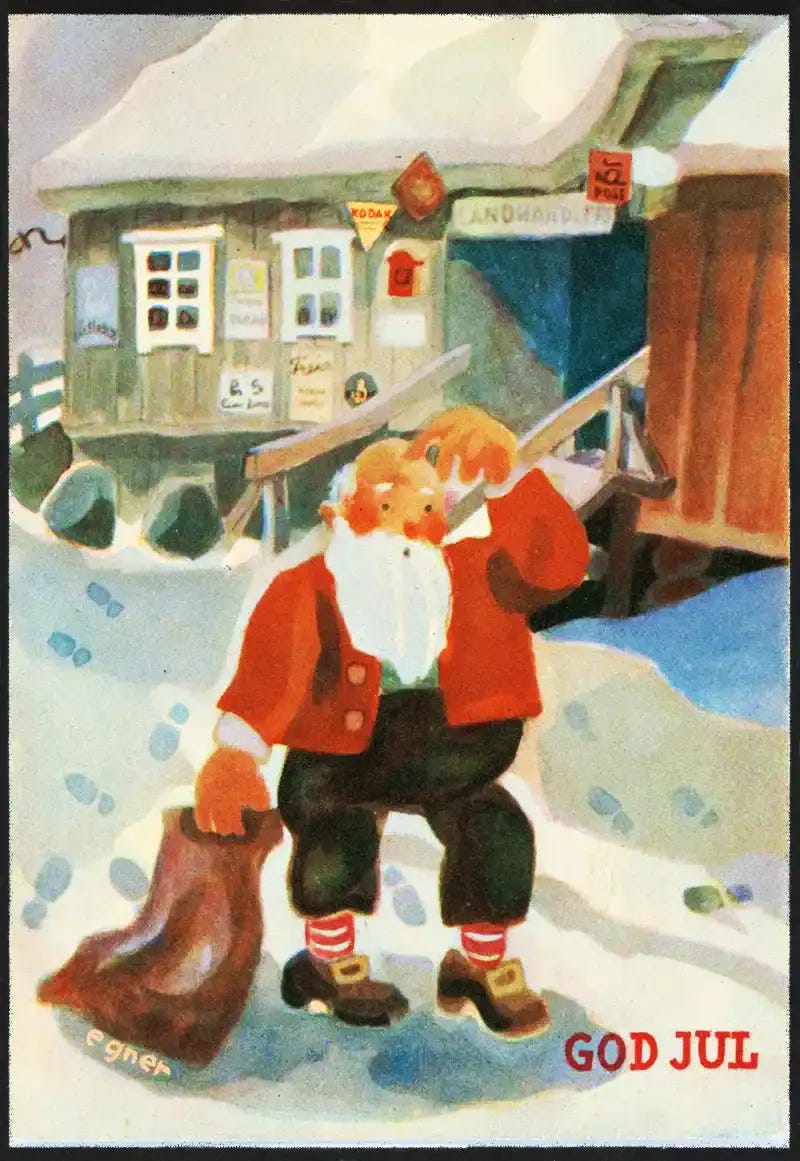
The Christmas cards suffered the same fate as the red hats, or, rather, the illustrated gnome hats did – the Nazis quickly put them on the chopping block. Still, limitations feed creativity, as shown in this illustrated card by Thorbjørn Egner. Here, Santa – the gnomes’ heir apparent – is visibly confused over where his hat went.
Other artists were more flagrant.
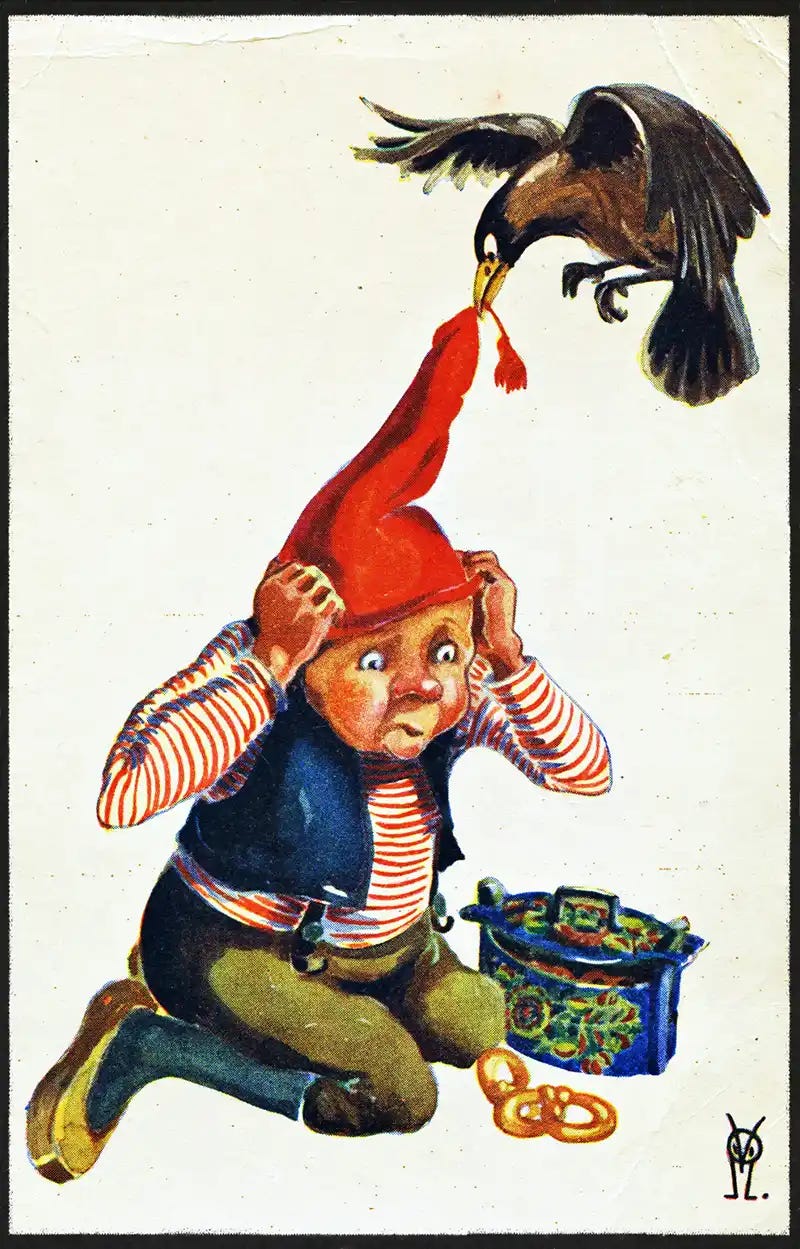
An illustration by Vigdis Rojahn shows a crow unsuccessfully trying to pick a hat off a gnome. Not a subtle message – the crow’s similarities to the Nazi Eagle are palpable – and the Gestapo arrested and interrogated the artist in their Oslo offices. Luckily, she was let go with a warning.
While plenty of these cards were printed, few were actually sent by mail – those that were often got intercepted by the Nazis. In all likelihood, people kept the cards in their homes as a silent protest against the occupying forces; many are preserved in the Norsk Folkemuseum (Norwegian Folk Museum).

Perhaps a more famous Norwegian World War 2 protest icon is the paper clip – the binders – which the resistance displayed on their lapel as a sign of unity. It had a short lifespan and was banned by the Nazis on September 25th, 1940.
Now, the paper clip itself has a sordid history, at least from a Norwegian perspective. Ask any self-respecting Norwegian, and they’ll tell you the country has come up with two major inventions: the cheese slicer and the paper clip. This is rooted in our upbringing and constitutes a point of national pride: the only reason you can clip papers together is because of Norwegian fortitude. You’re welcome!
Except… none of that is true. Not in the slightest, though Norway has done a good job of fooling the world. Look no further than the well-meaning “Paper Clips Project” for proof.
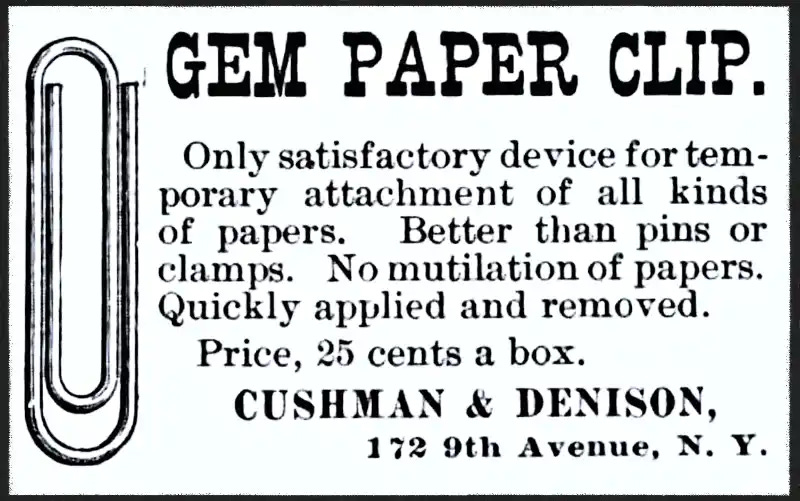
In reality, the first paper clip was patented by Samuel B. Fay in 1867, followed by Erlman J. Wright’s version in 1877. What we today fully recognize as a paper clip was introduced in 1892 by Cushman & Denison.
Johan Vaaler, the Norwegian credited with the invention, didn’t submit a patent application until 1901. It was rejected because… well… the paper clip already existed, and, thus, Vaaler’s version never entered production.
In other words, put the paper clip in the same bucket as Norway’s national chocolate bar, Kvikk Lunsj, which, for all intents and purposes, is Kit Kat in a different wrapper.



forskning.no: “Brukte nisseluer: Slik viste nordmenn motstand mot nazistene med julekort”
Wikipedia: “Binders”
Super interesting. Love to hear more about how folks have silently protested.