


Easter in Norway: a time when an otherwise secular denizen might meander to church before settling down with a good Påskekrim – an Easter-crime book. Not books set during Easter, but rather books read during the holiday.
Why does the genre become so ubiquitous at Easter? To find the answer, we need to travel back to the 1900s.
A Marketing Stunt That Still Resonates
A common misconception is that the Easter-crime trend kicked off with the 1923 book, Bergenstoget Plyndret Inat! (The Bergen Train Was Robbed Last Night! – an impossibly good title.) That notion isn’t entirely untrue, but it ignores the previous decade’s Easter-read blitz. During the weeks leading up to the 1912 holiday, publishers began promoting casual literature such as Sherlock Holmes in newspapers. Why Easter? Then, as now, Norway shut down for a week during its extended Easter holiday. Shops? Closed. You needed something to pass the time with.
Back to Bergenstoget Plyndret Inat! As a marketing ploy, publisher Gyldendal bought a headline on the front page of Aftenposten – Norway’s largest newspaper – which simply spelled out the book’s title. For the unassuming reader, it looked like an actual story about a large-scale train robbery. People freaked out – they had friends and relatives on the train! – and inundated Aftenposten with phone calls. For Gyldendal, the campaign was a success1.
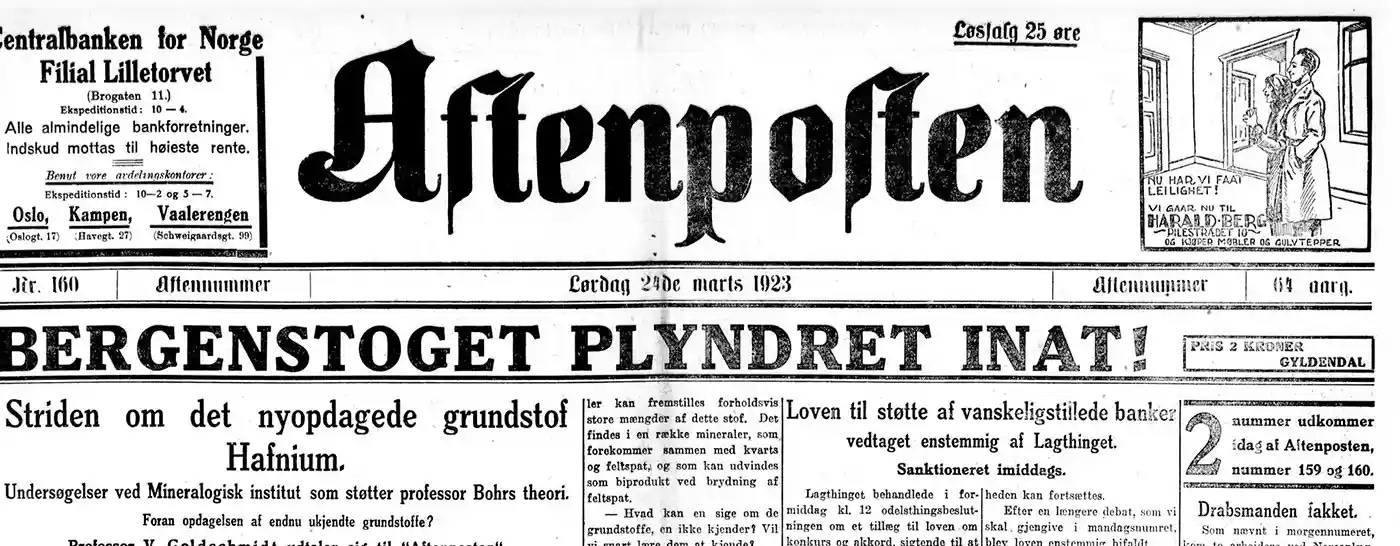
In that sense, this was when the Easter-crime concept took off earnestly, though it was still built on earlier marketing campaigns.
Time marched on, and publishers rode on Gyldendal’s success. The number of Easter-time crime novels grew, but it wasn’t until 1965 that the phrase “Easter crime” appeared in an advertisement for Aftenposten’s short story, Crime passionel på Ullabrent gård – a title I couldn’t even try to translate.
I’ll let others dive into the Scandinavian psyche and its fascination with (often violent) crime fiction, but in this case, the genre’s popularity is connected to something more benign: Easter crimes are not too different from the American summer-time beach read. When you have time to kill – no pun intended – whether at a ski cabin or on the beach, a crime novel is always an entertaining way to pass the time.
From Books to the Small Screen
As television sets spread throughout the seventies, the Norwegian state broadcaster, NRK, smelled blood in the water and jumped on the Påskekrim trend. Crime dramas gradually turned into Easter mainstays, and in 1977, Påskekrim serials became annual program posts. These were adaptations of mostly British authors – P.D. James was particularly popular – and the rest, as they say, is history.
These days, NRK and the many commercial channels broadcast multiple Påskekrims every evening. Some may claim they’ve oversaturated the market, but, judging by viewerships, there is no end in sight for the macabre seasonal Easter crime.

Jo Nesbø’s Detective Hole
With that, it should come as no surprise that Netflix released Norway’s large-scale crime production, Detective Hole (based on Jo Nesbø’s Harry Hole books), during this year’s Easter week. I managed to sit through a bleak, joyless six minutes and forty-three seconds before calling it quits. It’s not poorly made, but yow, it requires you to be in a particular mindset.
Some may also remember The Snowman, the 2017 Hollywood adaptation of the Harry Hole series. The movie contained only 80% of its shooting script and is a baffling, weird watch. Add to that, the director insisted on using the character’s name verbatim, which… Say it out loud, and get ready to snicker like a ten-year-old boy: Harry Hole2.
Additional Easter Crimes Courtesy of NRK
Norway’s state channel, NRK, recently published a list of Easter crimes for your viewing pleasure. Three of them stream in the US: Shetland (BritBox), Lynely (BritBox), and The Marlow Murder Club (PBS).

Web Sources
NRK: “Nordisk noir på full guffe“ (Mar 20, 2026)
Norsk Folkemuseum: “Easter Crime“
Wikipedia: “Påskeferie“ (Mar 31, 2026)
Aftenposten: “Illusjon ble påsketradisjon” (Apr 4, 2023)
Further (Non-Easter) Reads


Seven decades later, The Blair Witch Project would pull a similar stunt, and it’s fascinating how ahead of its time Gyldendal was.
The proper pronunciation: Hah-ree Who-leh. Or at least close to it – the English language doesn’t have the proper “who” sound.
Great read. Such an interesting tradition I'd always wondered about. I should read more out of Norway, too.